English
 Español
 عربى
عربى 中文简体
中文简体

There is a stainless steel tank inside every freestanding hot water dispenser, and for most of the day it simply sits at 85-95°C, waiting for someone to hold a mug under the red tap. No flame, no whistling kettle, no flash of steam. Press the tap, water leaves the tank, gravity or a small pump refills it from behind, and a thermostat switches the heating element back on a few seconds later. That single behaviour, a small volume of water held hot all day, explains almost everything buyers later ask about: why the first mug after switch-on takes minutes rather than seconds, why the stream slows to a trickle on some models, why water can taste flat after a week of standing, and why the cheapest unit on a quotation sheet is rarely the one still running three years later in an office corridor.
The Short Answer: Stored Heat, Not Instant Heat
Most hot water dispensers sold for homes, offices and light commercial use are storage appliances. A heating element warms a stainless steel reservoir of roughly 1 to 3 litres, a thermostat holds that reservoir inside a narrow temperature band, and the tap is little more than a valve at the bottom of the tank. The water feels instant only because it was heated twenty minutes earlier.
Genuinely instantaneous models exist too, mostly as under-sink taps and a few countertop units, and they work on a completely different principle: water is heated as it flows past an inline element, so there is no reservoir to keep warm. The trade-off is that flow rate decides temperature. A 1.5 kW element running on 230 V lifts water from 15°C to 95°C at roughly 0.25 litres per minute, which fills a mug in ten seconds but will not fill a teapot without going lukewarm.
So the useful question is not whether a dispenser is instant, but how much hot water you need, how fast, and how much standby energy you are willing to pay for. A 2-litre tank held at 90°C with reasonable insulation draws something in the region of 20 to 40 W on average, or roughly 0.5 to 1 kWh a day depending on room temperature and how often the tap is used.
How Water Actually Reaches the Hot Tank
A hot tank does not fill itself. Two plumbing layouts do the work, and the choice between them matters more to daily use than any electronic feature on the front panel.
Top-loading: gravity and vacuum
The bottle sits upside down on a probe above the cold tank. Water runs down into the tank until the bottle's own water level drops below the mouth of the probe; at that point air can no longer enter the bottle, a partial vacuum forms, and the flow stops. A connecting tube links the cold tank to the hot tank, and the hot tank carries a thin breather tube that returns displaced air back up into the bottle so the two tanks can exchange water without pressurising. That breather is also why a top-load machine may refuse to pour hot water when the bottle is empty, or when the cabinet is tilted during a move.
Bottom-loading: a small pump does the lifting
In a bottom-load unit the bottle stands upright inside the lower cabinet. A food-grade silicone tube drops into the bottle and a small diaphragm or gear pump, typically drawing 20 to 40 W, lifts water into the reservoirs. Float switches or conductivity probes cut the pump when the tanks are full. Because the bottle is never inverted, an 18.9-litre bottle can be changed at waist height, which is the main reason offices move to this layout once anyone has had to lift a full bottle onto a spike.
The same interior hardware is reused across cabinet sizes, so a buyer comparing a tall freestanding unit with a compact one is usually comparing tank volume, element wattage and pump quality rather than a different working principle.
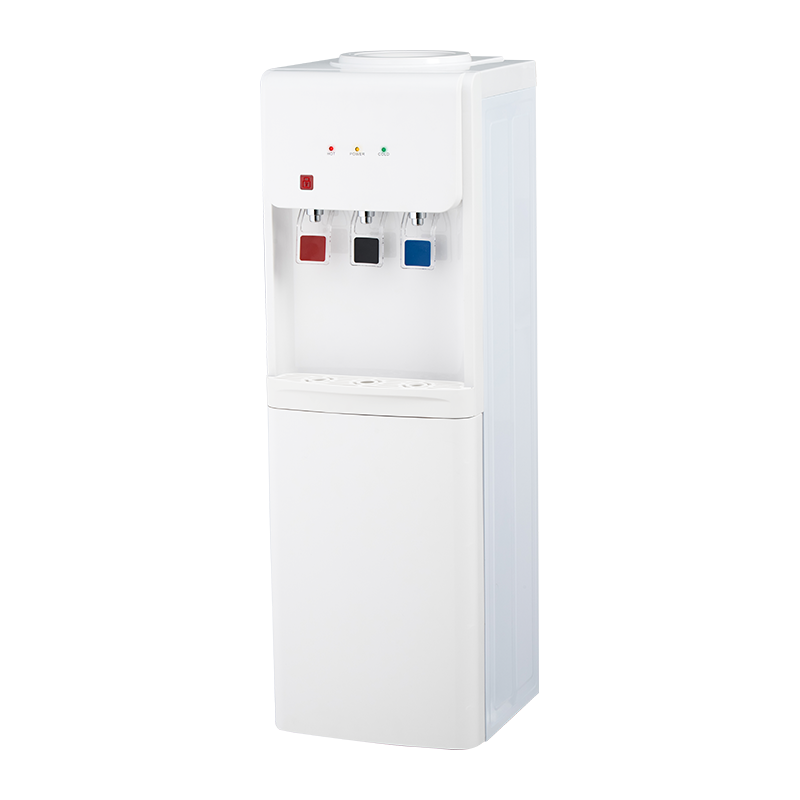
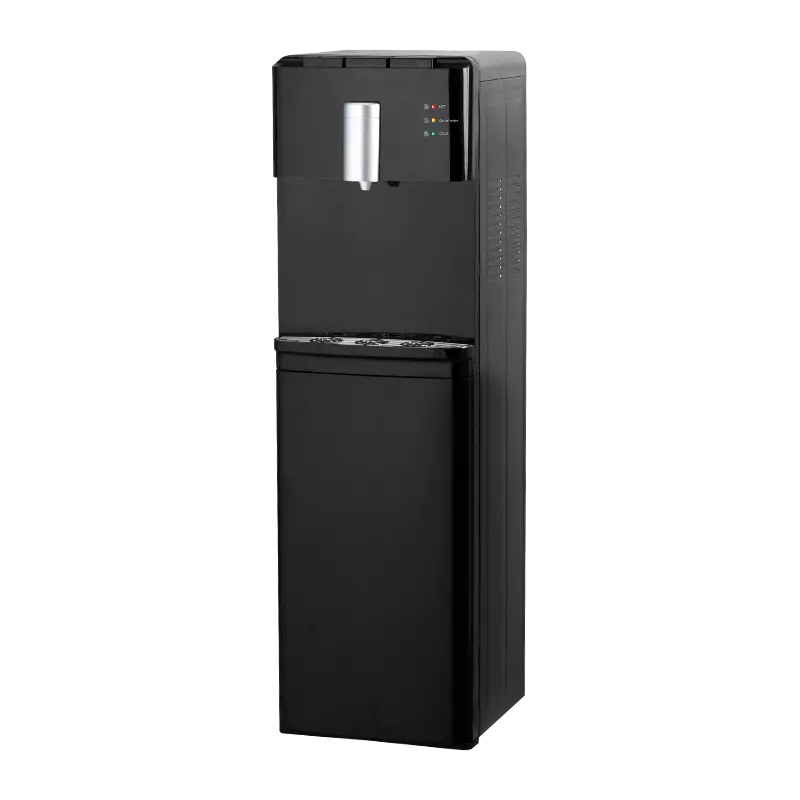
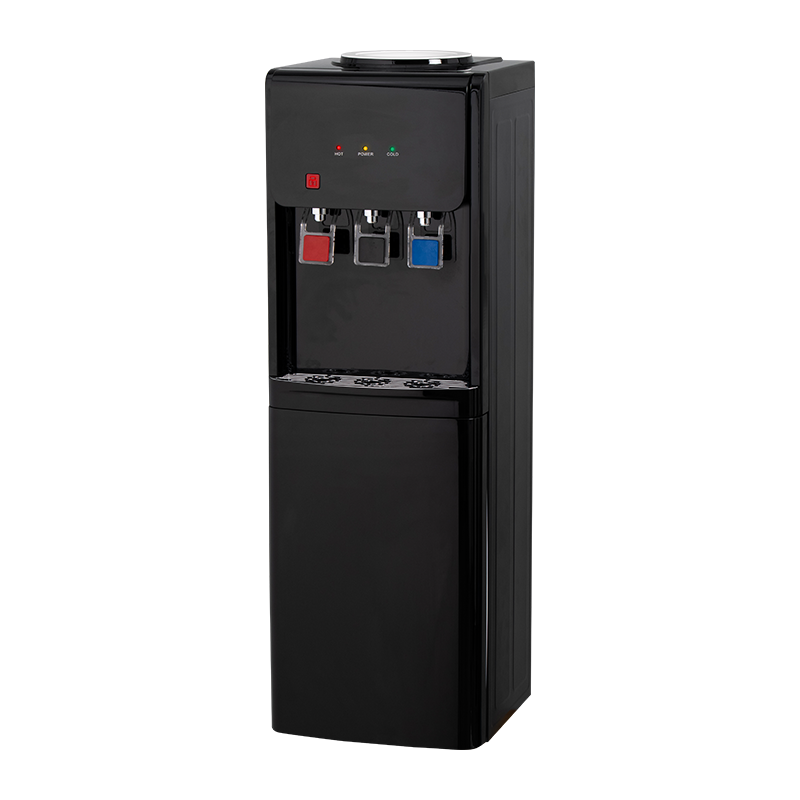
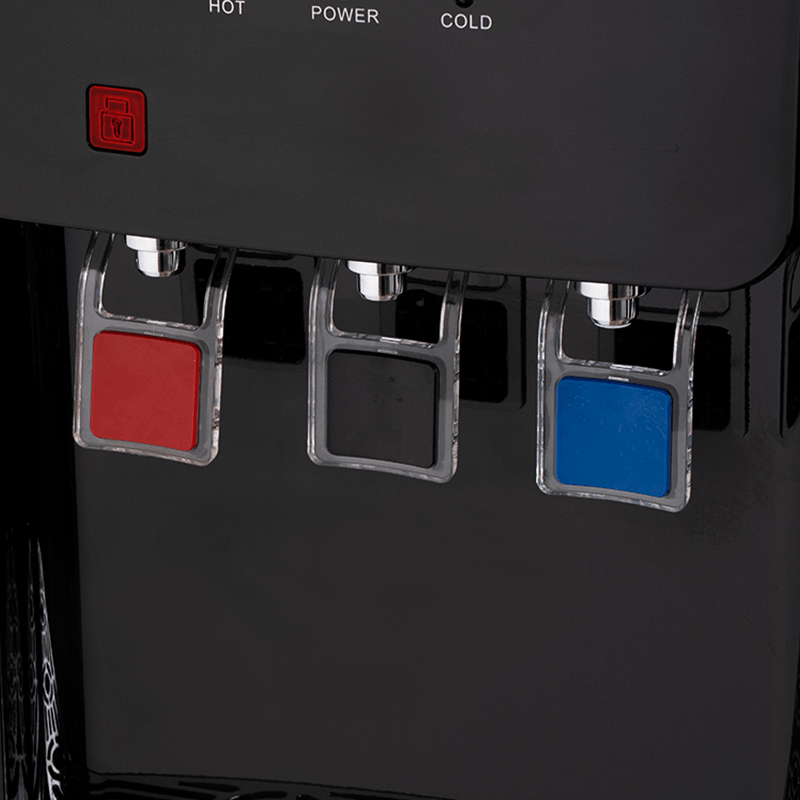 YR-2506 Series Black Vertical Hot and Cold Water DispenserThree black vertical models provide hot, room-temperature and cold water, with electronic or compressor cooling, differing cold-water output and optional freezer cabinet.View Product →
Inside the Tank: Element, Thermostat, Vent and Two Cutoffs
Take the cabinet apart and the hot side is a short list of parts, each of which has a job you can check on a specification sheet.
- Heating element: an immersion element of 500 to 800 W in most freestanding dispensers, sheathed in stainless steel and mounted through the tank wall or wrapped as a band around it.
- Thermostat: a bimetallic disc that opens at the set point, usually 85-95°C, with 5 to 10 K of hysteresis so the element is not switching every few seconds. Better units use an NTC thermistor and a control board instead.
- Thermal fuse: a one-shot device wired in series with the element, rated to open permanently somewhere around 120-140°C if the thermostat ever welds shut.
- Vent or breather tube: gives expanding water and trapped air somewhere to go when the tank heats, instead of forcing water back towards the bottle.
- Check valve: stops hot water migrating backwards into the cold tank, which would otherwise warm the drinking water and confuse the cold thermostat.
- Tank: food-grade stainless steel, commonly grade 304, with a seam that is welded rather than crimped on units built for a long service life.
Two independent cutoffs are the difference between a nuisance and a fire risk. A single thermostat that fails closed will keep heating until something gives way, which is what the fuse exists to prevent. When a dispenser is described as having double overheating protection, this is what the phrase should mean.
Tankless and Under-Sink Units: Heating Water on the Way Through
An inline heater replaces the reservoir with a coil or a thick-film element wrapped around a flow-through tube. A flow sensor, either a small turbine with a hall-effect pickup or a pressure differential switch, tells the control board that water is moving; an NTC sensor on the outlet measures how hot it came out; a relay or triac then modulates the element. There is no stored volume to keep warm, so standby consumption is close to zero.
The physics sets a hard limit. Raising water from 15°C to 95°C takes about 4.19 joules per gram per degree, so half a litre per minute requires roughly 2.8 kW. That is why a 1.5 kW tap throttles itself to about a quarter of a litre per minute, and why an oversized flow rate is the fastest way to get disappointing water. It is also a wiring question: 1.5 kW at 120 V draws 12.5 A, and 3 kW at 240 V draws the same, so a dedicated circuit is normally required rather than a shared kitchen ring.
Worth knowing before you compare prices: many taps marketed as instant are hybrids, combining a small 0.7 to 1.3 litre tank with a 1.4 kW element so that they can deliver a mug in seconds and then recover between pours. Asking which architecture a supplier actually uses is a quick way to separate two very different products.
When Hot and Cold Share a Cabinet
Add a cold tank and the machine gains a refrigeration circuit. A hermetic compressor of 60 to 100 W drives refrigerant through a condenser coil on the back or side, past a capillary tube, and into an evaporator coil wrapped around a 2 to 4 litre cold tank; a thermostat holds the tank between roughly 5 and 10°C. At a 25°C room temperature the compressor typically runs 15 to 25 minutes and rests for 30 to 45, which is why the back of the cabinet stays warm and why 100 mm of clearance behind the unit is a real installation requirement rather than a suggestion.
Small desktop machines often skip the compressor entirely and use thermoelectric modules instead. They are silent, contain no refrigerant, and draw 60 to 120 W, but the cold side only sits about 10 to 15°C below ambient and recovery after a pour is slow. For a desk used by two or three people that is fine; for a staff kitchen it is not.
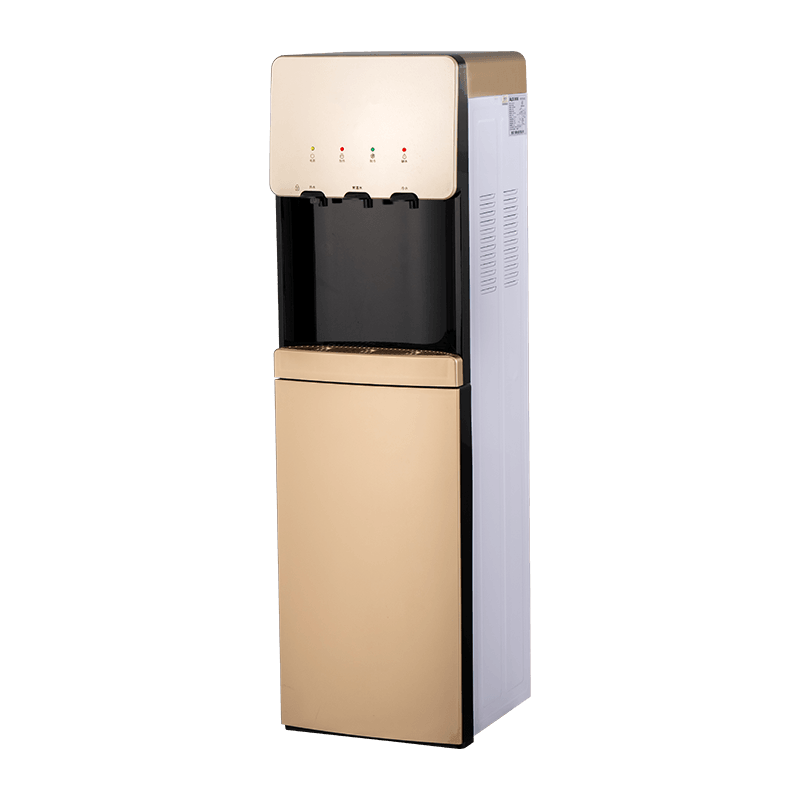
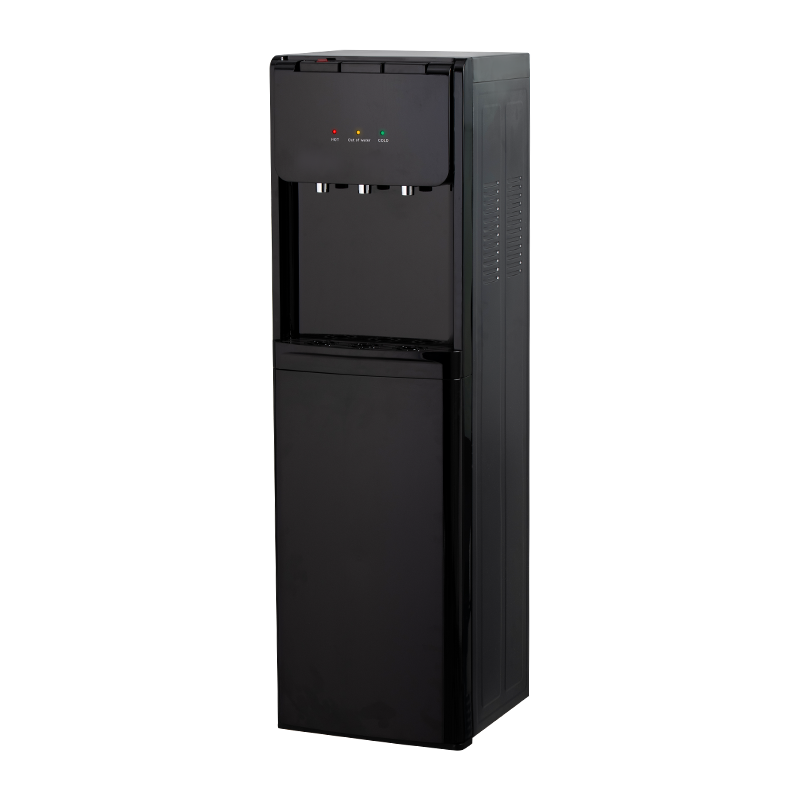 YX-2505/YLX-2505 Black Bottom-Mounted Hot and Cold Water DispenserBottom-mounted black dispenser offers hot, room-temperature and cold water; YX-2505 uses electronic cooling while YLX-2505 uses compressor cooling for faster chilling.View Product →
In a bottom-loading cabinet the hot tank, cold tank, compressor and pump share one shell, so service access matters. Look for a rear panel that comes off with a few screws and a drip tray that lifts out, because those two details decide whether routine cleaning takes five minutes or an hour.
Why Dispenser Hot Water Tastes Flat, and What Scale Does to It
Holding water at 90°C for hours drives off dissolved oxygen and carbon dioxide, and that alone flattens the taste compared with freshly boiled water. Two further effects build up over time. Dissolved minerals concentrate slightly as water is repeatedly reheated, and limescale deposits on the element insulate it, so the sheath runs hotter, recovery slows, and the thermal fuse eventually opens on a unit that never actually broke.
Hard water accelerates this. Where total hardness runs above roughly 200 mg per litre as calcium carbonate, descaling with citric acid or a dilute vinegar solution once or twice a year is normal maintenance rather than a repair. The silicone draw tube, the drip tray and the cold tank are the other places biofilm forms, and hot water picks up more from a scaled tank than cold water does. Some bottom-load units now include a self-cleaning cycle that flushes the tank on a schedule, which is useful in rented offices where nobody owns the maintenance calendar.
If you want that convenience built in rather than improvised with a bottle of citric acid, a self-cleaning bottom-load cooler removes most of the guesswork from the routine.
Recovery Time, Wattage and the Numbers Behind the Brochure
Recovery time is the figure buyers underestimate most often. A 2-litre tank does not empty in one mug, but it does empty during a meeting, and the wait afterwards is set by element wattage divided into the energy needed to reheat the refill. Desktop units trade tank volume for footprint, and a 1-litre tank with a 600 W element needs eight to twelve minutes to come back from cold; a full-size tank does it in five to eight.
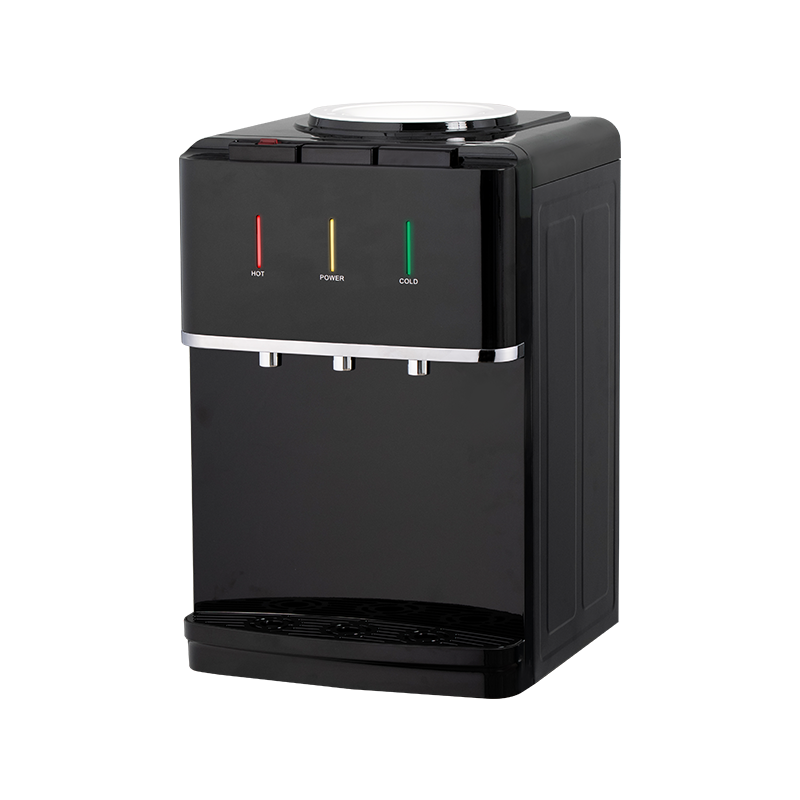
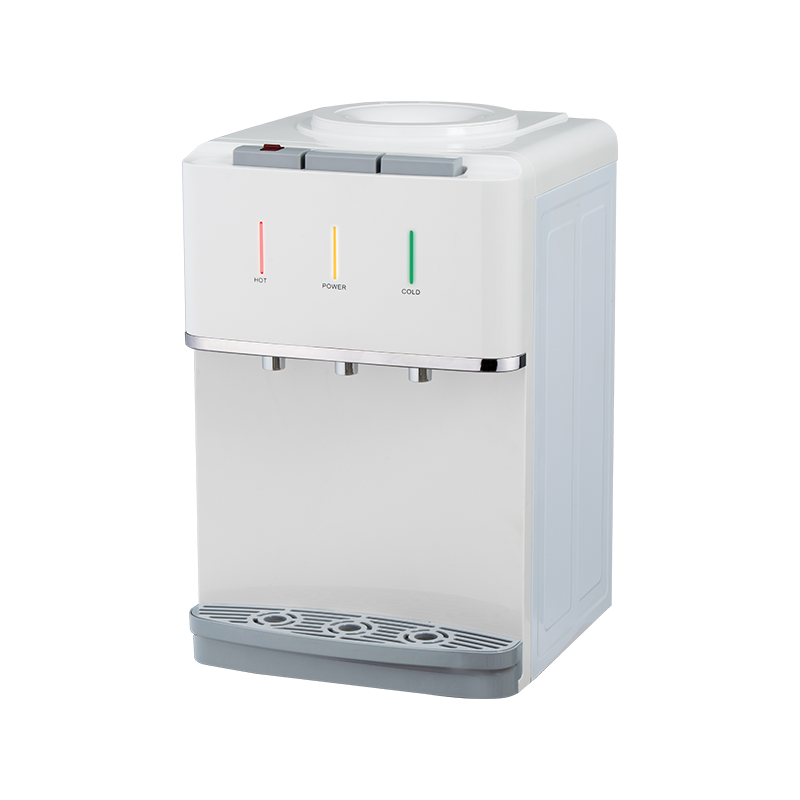
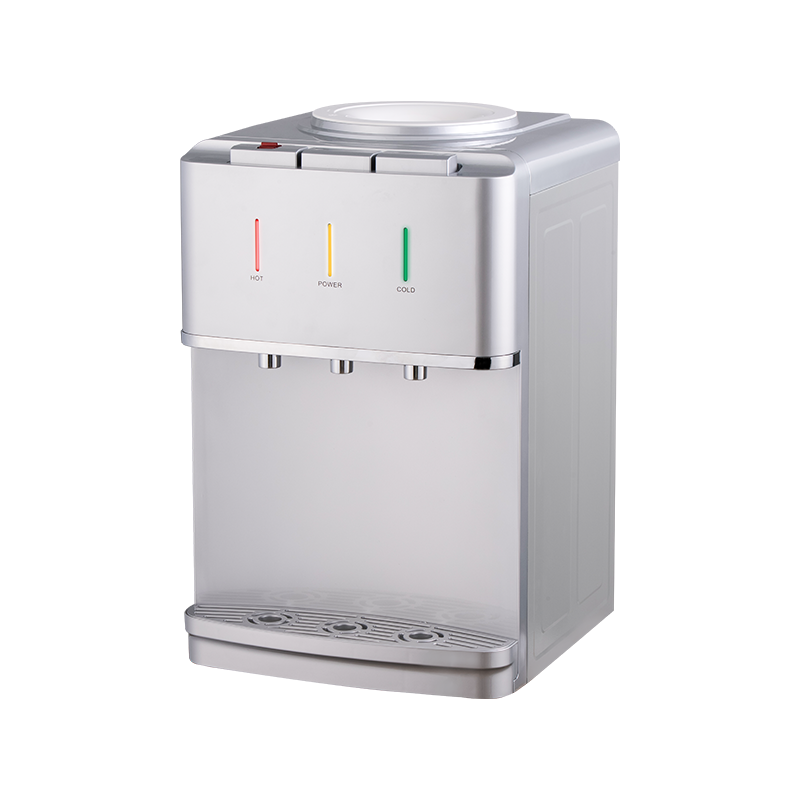
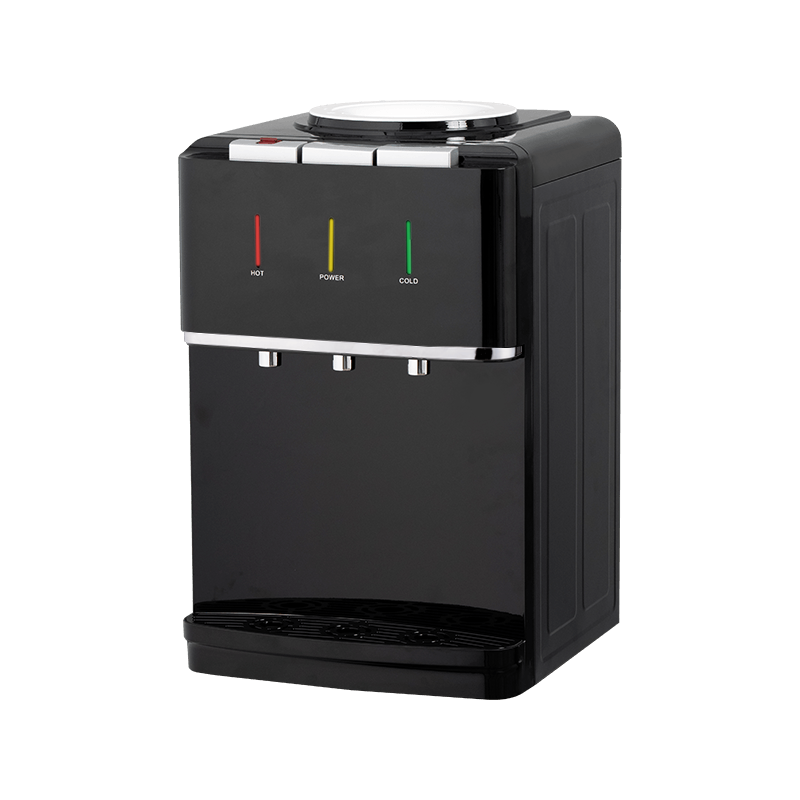
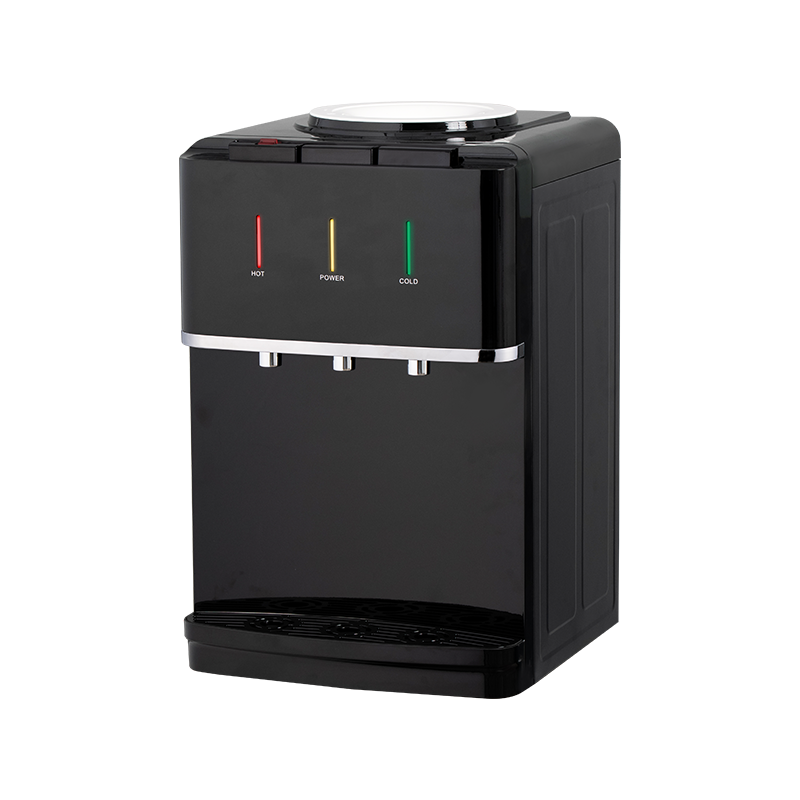 YR-2508T/YLR-2508T Black Desktop Hot and Cold Water DispenserCompact black desktop dispenser provides hot, room-temperature and cold water; YR-2508T uses quiet electronic cooling, YLR-2508T uses compressor cooling for steady output.View Product →
| Configuration | Heating or cooling method | Typical power | Time to hot water | Fits best |
|---|---|---|---|---|
| Top-loading freestanding, hot and cold | Immersion element in a 1.5-2.5 L stainless tank | 500-800 W | 8-15 minutes from cold, then 5-10 seconds per mug | Homes and small offices where lifting a bottle is acceptable |
| Bottom-loading freestanding | Same tank plus a lift pump | 20-40 W pump, 500-800 W element | 60-90 seconds to first fill, then as above | Offices and reception areas where staff should not lift bottles |
| Desktop or countertop | Smaller tank, lower wattage | 400-700 W | 8-12 minutes from cold | Desks, small teams, rented space |
| Under-sink instant tap | Inline coil or 0.7-1.3 L micro tank | 1.4-3.0 kW | 3-15 seconds, continuous flow capped near 0.25-0.5 L per minute | Kitchens and tea points with a dedicated circuit |
| Cold side, compressor type | Hermetic compressor, condenser, evaporator coil | 60-100 W | 30-60 minutes from room temperature | Hot and cold machines in warm rooms |
What to Verify Before Ordering in Volume
Catalogue photographs all look alike, so the differences have to be pulled out of the paperwork. A short checklist covers most of the risk.
- Heater wattage and tank volume, stated separately for the hot and cold sides rather than as one combined figure.
- The number and type of over-temperature protections, with the fuse rating written down.
- Market voltage and frequency, 220-240 V at 50 Hz or 120 V at 60 Hz, plus the plug and cord length.
- Flow rate at the stated delivery temperature, not only the maximum flow.
- Wiring requirement for any inline heater, including the circuit rating it assumes.
- Certification documents for the destination market, plus food-contact declarations for the silicone tubing and the tank material.
- Spare parts availability: taps, thermostats, silicone tube, filters and drip trays.
- Minimum order quantity and how the colour mix is handled, since many models ship in black, silver and white variants of the same chassis.
A written specification is worth more than a photograph, and the same applies to the supplier. A brief company profile that names the factory, the product lines it actually builds and the markets it ships to tells you whether the hot tank is made in-house or bought in.
One last point about expectations. A hot water dispenser is not a kettle and is not meant to be. It is a small, continuously warm reservoir with a valve, a thermostat and two safety devices, and it does that job well when the tank is sized to the room and the element is sized to the tank. Match those three numbers to how the machine will actually be used, and the rest of the specification becomes far easier to judge.